

Why a Marketing Agency Shouldn’t Rebuild Your Website
You’d be surprised how many times clients come to us to rescue a brand new website. Yes, sadly, you read that correctly. Clients come to us because they have spent time and invested considerable funds in designing and developing a brand-new website that is now significantly buggy, under-performing, or worse, broken, and still not finished. In short, the site looks modern, but its functionality is a mess.
If you’ve found yourself in this predicament, please contact us, as we can usually help remedy the situation without having to rebuild your entire website. But if you’re wondering why we so strongly advocate for an agency that specializes in WordPress development to develop your website, read on!
1. Great Design Isn’t the Same as Great Development
Many marketing agencies excel at designing print assets and social media assets, but websites are vastly more complex. Marketing agencies are great at helping you establish your brand kit, finding your online voice and audience, or focusing on content that will drive your sales funnel. However, that doesn’t mean they are WordPress experts.
Here are just a few problems we’ve encountered when the on-surface design appears modern but fails upon implementation.
- Layouts that don’t have both tablets and smartphones in mind
- Layouts that break when localization of other languages is involved
- Animations that kill page speed and look like a video game run amok
- Overly complex carousels that are inaccessible and kill website speed
- Images and videos that are not optimized for the web
- Menus that are trendy but confuse visitors
- Glitzy video and/or animation that no one wants to sit around and watch load
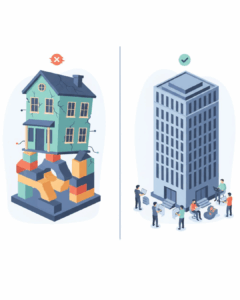
Design is essential, and many of the above pain points can be avoided when experienced developers know how to include cutting-edge design options thoughtfully with user experience (UX) and not pixel-perfection being the driving factor behind every decision. But design without solid development is like building a house on unstable ground. It might look good at first, but cracks soon happen, and then everything caves in.
2. Bloated Page Builders
Many marketing agencies aren’t writing code; instead, they’re using page builders like Elementor, Divi, or WPBakery without knowing how to optimize them. Pagebuilders are great for folks who are just starting out doing everything themselves, or for SMEs with a limited budget. However, once your business has grown and continues to scale, page builders frequently provide challenges in several areas:
- These add-on page builders introduce bloat for functionality that is already natively available in WordPress core, such as drag-and-drop features, reusable content patterns, and more. The result is a significant impact on your Core Web Vitals (CWV), which in turn negatively affects your SEO.
- Yearly licensing cost for tie-in products that extend the page builder functionality when the identical functionality is often available in WordPress core, using a line of code, or a less bloated plugin/third-party integration.
- Page builders typically cause accessibility issues that make it difficult or impossible for users with screen readers or keyboard-only controls to use your website.
An experienced development-focused agency utilizes native WordPress core blocks, custom blocks only when necessary, and/or reusable block patterns to create the varied looks their clients require. They build with performance, accessibility, and scalability in mind from the get-go. Here’s a good Core Web Vitals tester. A newly built website should achieve a high passing score when testing Core Web Vitals. It’s also helpful to ask the following question. Does your marketing agency’s own website achieve these results?
3. Accessibility Gaps
There is absolutely a way to implement any brand’s logo and color scheme in a thoughtful way that maintains accessibility. Too often, we’ve seen websites that feature a beautiful design with a brand’s colors. However, no attention was paid to the actual user experience.
We have encountered font sizes below industry-recommended Web Content Accessibility Guidelines (WCAG) 2.2 standards, color options that fly in the face of reason, such as green text on a blue background, presenting challenges for anyone with or without visual challenges, such as colorblindness, and no thought given to how items that contrast appropriately on desktop don’t always contrast appropriately on mobile.
Beyond surface-level, highly avoidable contrast errors, we’ve seen no editorial safeguards implemented around alt text, missing or incorrectly implemented ARIA (Accessible Rich Internet Applications), and keyboard traps that prohibit users from accessing vital areas of the website, such as contact forms or checkout workflows.
Experienced developers code with WCAG 2.2 standards in mind from the get-go, because accessibility isn’t a nice-to-have feature; it’s a necessity.
4. Outsourced Development without Oversight 
We frequently receive clients who come to us stating that the developers a marketing agency subcontracted with constantly rotate. They don’t really get to know the client, their needs, or their website in any meaningful way. Additionally, there is no knowledgeable staff member at the marketing agency who can adequately supervise and vet these individuals and their work.
Outsourced developers often do exactly what is requested rather than asking the necessary questions, because they are not invested in long-term relationships. They have been contracted for a short-term, specific assignment, and that is it. When something breaks, the developer of the day has to handle it, having little to no context on how the site was architected by the previous developer.
Lastly, another often frustrating aspect is part-time developers who are not US-based and don’t respond to questions during US business hours. This results in an elongated development time to complete even the simplest tasks, due to 8-10 hour lags between communications.
5. Downtime and Breakages
What does your agency have in place for version control? Rolling back to the previous night’s backup isn’t a great option, especially if you have a membership or e-commerce website. Nothing like duplicated sales, lost sales, and messed-up memberships to wreck customer satisfaction.
Your developers should not make changes to your live production website unless they have first been tested on a staging or development environment to ensure that no unforeseen breakages or downtime will occur.
Additionally, services like GitHub or BitBucket should be used in case there is an issue. These version control platforms provide a centralized and secure location for storing code, tracking changes, and collaborating across teams. By maintaining a complete history of every edit and deployment, they make it easy to identify when and where an issue occurred, revert to a previous stable version, or compare code differences. This not only safeguards against data loss or accidental overwrites but also ensures accountability, transparency, and smooth coordination between developers working on the same project.
6. Plugin Overload
A marketing agency’s go-to solution for any functionality tends to be: “Let’s find a plugin”. Often, no real vetting of that plugin is done. This raises important questions, such as: Is it from a reputable developer? Do they respond promptly to support questions? Is it regularly updated? Does it have additional features that are duplicated or unnecessary?
Before you know it, your website has 30+ plugins, many of which are unused, redundant, outdated, and/or conflicting with each other. This means your website is at risk for everything from a hit on your Core Web Vitals to potential security intrusions.
An engaged senior developer knows how to write a few lines of code, integrate an API, or even a lightweight custom solution, instead of stacking plugins like a house of cards ready to collapse.
7. Hosting Conflicts of Interest
You need appropriately sized WordPress-optimized hosting for your website. If you’re being hosted through your marketing company’s reseller account, several potential issues can arise.
You may be unaware of how many other businesses share your server. It could be Black Friday or another big sales day, and the traffic from your marketing agency’s other clients causes slowdowns on your site. There may be way too many websites on a server fully tapping out its resources.
Does the marketing company know how to discuss caching, CPU, RAM, and PHP, and understand their impact on performance in relation to the hosting company? As a general rule, marketing agencies don’t speak in terms of query load, index optimization, or slow query logs. They can tell a site is slow, but they can’t communicate with the developers at the hosting company in a nuanced way to make informed decisions together.
Here’s the worst part: you have no insight into any of the above because it’s not your hosting account, it’s theirs. The host has zero responsibility to you, only to the organization that directly purchased the hosting. This is why we always recommend clients buy their own hosting and grant us developer access. With a WordPress agency that specializes in websites, you have the security, transparency, and accountability you deserve, without any conflict of interest.
Why should you have a development agency and not a marketing agency build your website?
Do we dislike marketing agencies? No, we love them and count many of them amongst our trusted network of partners. When clients need a marketing agency, we refer them to experts with whom we have worked before who possess the necessary skill sets to assist them.
Ultimately, it comes down to the following: different professionals are there to meet different needs. Most agencies can’t and, in fact, shouldn’t try to do everything. You don’t want to work with the proverbial “Jack of all trades, master of none.”
If you’re planning a rebuild, find a development agency that is committed to collaboration with your marketing team and/or an outside agency.
A solid development partner will:
- Build using WordPress standards (blocks, block patterns, block-based themes)
- Prioritize accessibility, Core Web Vitals, and performance from day one
- Keep your site lightweight and maintainable without plugin bloat
- Provide knowledgeable, consistent, and timely documentation and support
Marketing agencies are great at what they do, but when it comes to building a site, you need developers who prioritize performance, scalability, and long-term sustainability.
Building a site that is truly cutting–edge requires more than pretty graphics and a page builder. Visit our website services page for more information!